A sweatband is a deceptively simple product, and almost everything a buyer cares about — how much sweat it holds, how it feels an hour into a match, whether a logo stays crisp after thirty washes — is decided by the fabric long before decoration ever enters the conversation. If you are ordering in bulk, the fiber blend is the specification that matters most and the one most order forms leave vague. This guide walks through what custom sweatbands are actually made of, and how each material choice changes performance on the wrist and the head.
The two jobs the fabric has to do
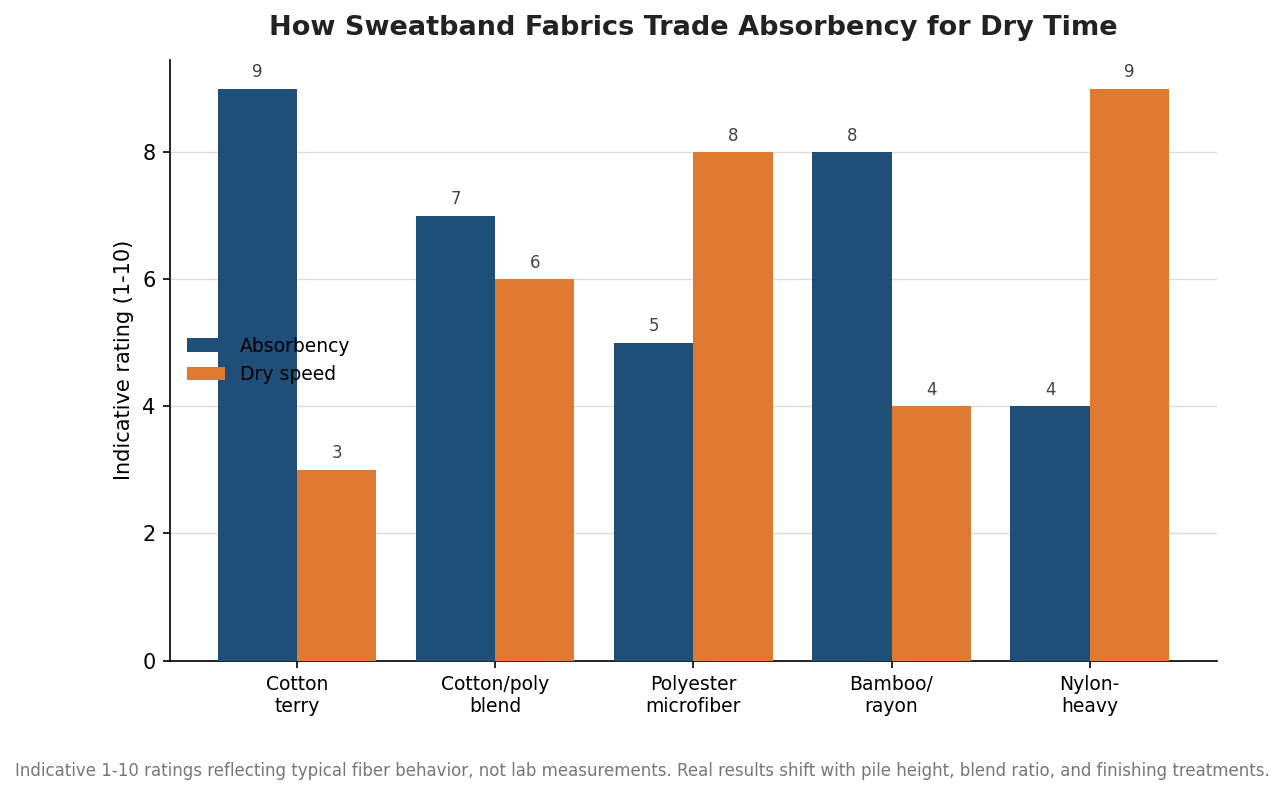
Absorbing and wicking are not the same thing, and a good sweatband has to balance them. Absorption means the fiber soaks sweat into itself and holds it, which is what keeps perspiration from running down into your eyes or off your palm. Wicking means the fiber pulls moisture along its surface and spreads it out to evaporate quickly, which is what keeps the band from staying soggy. Natural fibers like cotton are excellent absorbers and poor wickers; most synthetics are the reverse. There is no single fiber that does both perfectly, which is why the blend, not any one material, is what you are really buying.
The chart below shows the trade-off in qualitative terms. Treat the numbers as a relative guide to fiber behavior rather than lab data, because pile height, blend ratio, and any finishing treatment can shift real-world results substantially.
Terry cloth, and why cotton still dominates the wrist
The classic athletic wristband is terry cloth, which is not a fiber but a construction: loops of yarn are woven or knitted so they stand up off the base fabric, and each loop is extra surface area for grabbing moisture. Cotton terry is the default because cotton absorbs several times its weight in water and feels soft against skin that is being rubbed repeatedly. The downside is real: cotton holds that water rather than releasing it, so a heavily saturated cotton band gets damp and stays damp, and it takes longer to dry between sessions. For a tennis player who swaps bands or a gym user wiping an occasional brow, that is a fine trade. For a full 90-minute match in heat, many buyers step up the synthetic content.
Loop density also matters more than most spec sheets admit. A denser, taller terry pile holds more sweat and feels plusher, but it also uses more yarn, adds weight, and costs more per unit. When two quotes for “cotton terry wristbands” differ noticeably in price, pile weight is often the hidden variable, so it is worth asking a supplier for the fabric weight or at least a physical sample before committing a large run.
The stretch layer: elastane, nylon, and staying put
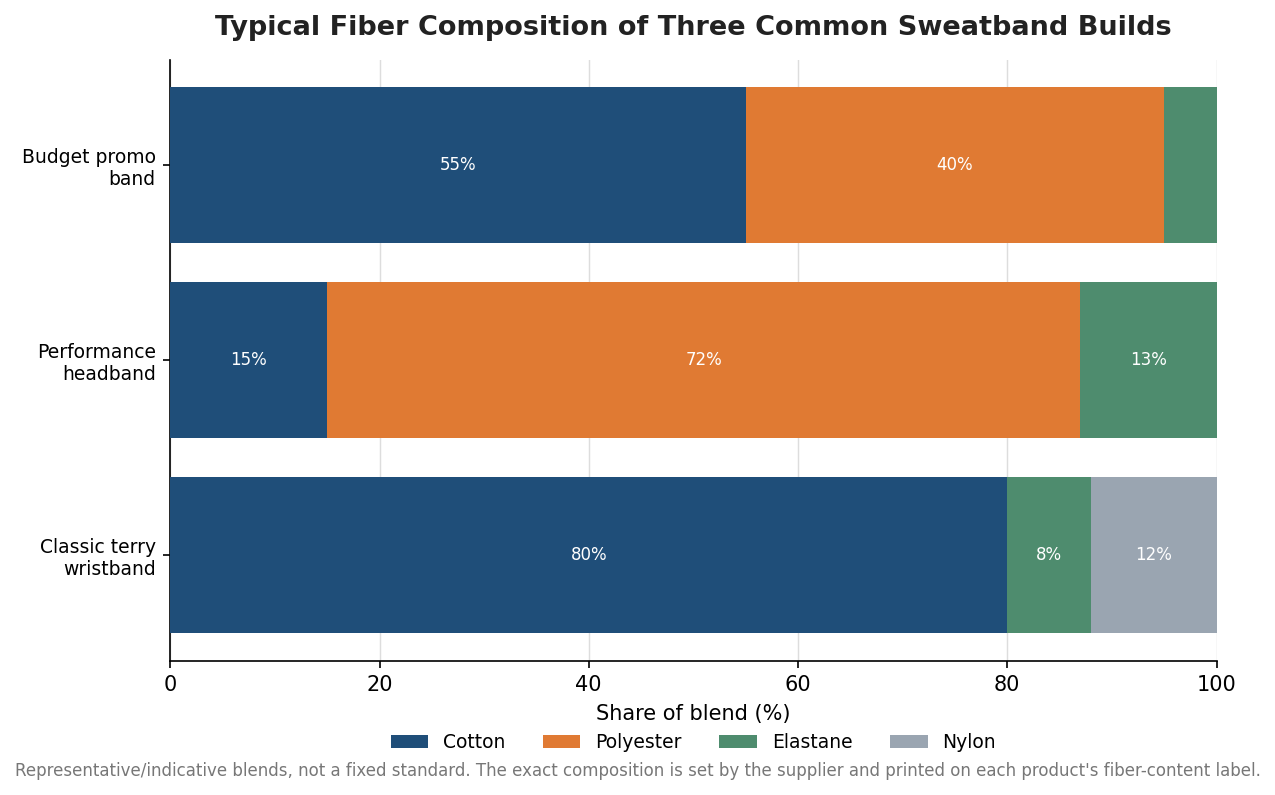
A band that will not stay in place is useless no matter how absorbent it is, and stretch comes from a small percentage of elastomeric fiber blended into the yarn. Elastane, sold under names like Spandex and Lycra, is the usual choice; even five to fifteen percent gives the band the recovery it needs to grip without cutting off circulation. Nylon frequently appears alongside it to add durability and a bit of structure, since pure cotton-and-elastane blends can go slack over time. This is why a typical terry wristband is not “100% cotton” at all but something closer to a cotton-nylon-elastane mix, with the cotton doing the absorbing and the other two fibers handling fit and longevity.
Headbands lean harder on synthetics because they sit on a smaller, more mobile area and are judged more on staying power than on raw capacity. A performance headband is often mostly polyester with a meaningful slug of elastane, which keeps it light, quick to dry, and firmly seated during running or high-intensity work. The chart below shows how three common builds tend to divide up their fiber content.
Reading a blend spec before you approve a run
The fiber-content label is the real specification, and it is worth reading the way you would read ingredients. A high cotton percentage signals a soft, absorbent, slower-drying band suited to racquet sports and casual wear. A high polyester percentage signals a lighter, faster-drying, more color-stable band suited to running, obstacle events, and anything worn in sustained heat. The elastane figure tells you how much grip and recovery to expect, and a nylon figure hints at added durability. None of these is universally “better” — they describe different products, and the right one depends entirely on how the band will be used.
Blend also quietly governs decoration. Polyester-rich fabrics take dye-sublimation printing beautifully, which is how you get edge-to-edge color and photographic logos, but sublimation does not work on cotton. Cotton-rich terry, by contrast, is the natural home of embroidery and woven-in designs, which sit well on a looped pile and survive repeated washing. If your artwork is full-color and complex, you are implicitly specifying a synthetic-heavy fabric; if it is a clean embroidered mark on a plush cotton band, you are specifying terry. Deciding the decoration and the fabric together, rather than in sequence, avoids the common surprise of a design that cannot be produced on the material already chosen.
Matching the material to the job
Start from the use case and let it choose the fiber. For racquet sports, weightlifting, and general gym wear where a soft feel and high absorbency win, a cotton-dominant terry blend with a touch of elastane and nylon is the proven choice. For running, team field sports, and hot-weather events where fast drying and vivid full-color branding matter more, a polyester-led blend with elastane earns its place, and it will hold a sublimated logo that cotton simply cannot carry. For low-cost promotional giveaways handed out at scale, a balanced cotton-polyester band keeps the unit price down while still feeling like a real sweatband rather than a token.
Whatever the application, ask any supplier for the exact fiber percentages, the fabric weight or pile description, and a physical sample before a large order. Those three details tell you more about how a custom sweatband will actually perform than any product photo, and they cost nothing to request. Get the material right and the decoration, the fit, and the longevity tend to follow; get it wrong and no amount of good printing will save a band that soaks through in the first ten minutes or slides off in the second.