Ordering custom sweatbands with a logo looks simple, but the box that arrives can vary a great deal depending on four decisions you make before production starts: the fabric, the band size, the decoration method, and the quantity. Get those right and a sweatband becomes a genuinely useful piece of team kit or promotional swag that survives repeated washing. Get them wrong and you end up with a band too narrow to wick sweat, a logo that blurs after a month, or a per-unit price far higher than it needed to be. Here is how to specify each part.
Start with the fabric, because it decides how the band wears
Nearly every athletic sweatband is knitted from terry cloth, the same looped-pile construction used in towels. Those tiny loops are what pull moisture off the skin, so a genuine terry band absorbs far more than a flat-knit fashion band of the same width. Most terry sweatbands are predominantly cotton for softness and absorbency, blended with a share of polyester for shape retention and a few percent of spandex so the band stretches over a hand or head and springs back. A well-made terry band should survive 100 or more wash cycles without losing its stretch, which matters if you are buying for a team that will launder them weekly.
If your design calls for bright, exact brand colors, ask what the base blend is before you approve anything. Higher-cotton bands take embroidery beautifully but can look slightly muted under dye-sublimation, while higher-polyester bands hold printed color more vividly. There is no single correct answer here, only a trade-off between hand-feel and color pop, so decide which one your logo depends on.
Match the band width to the sport
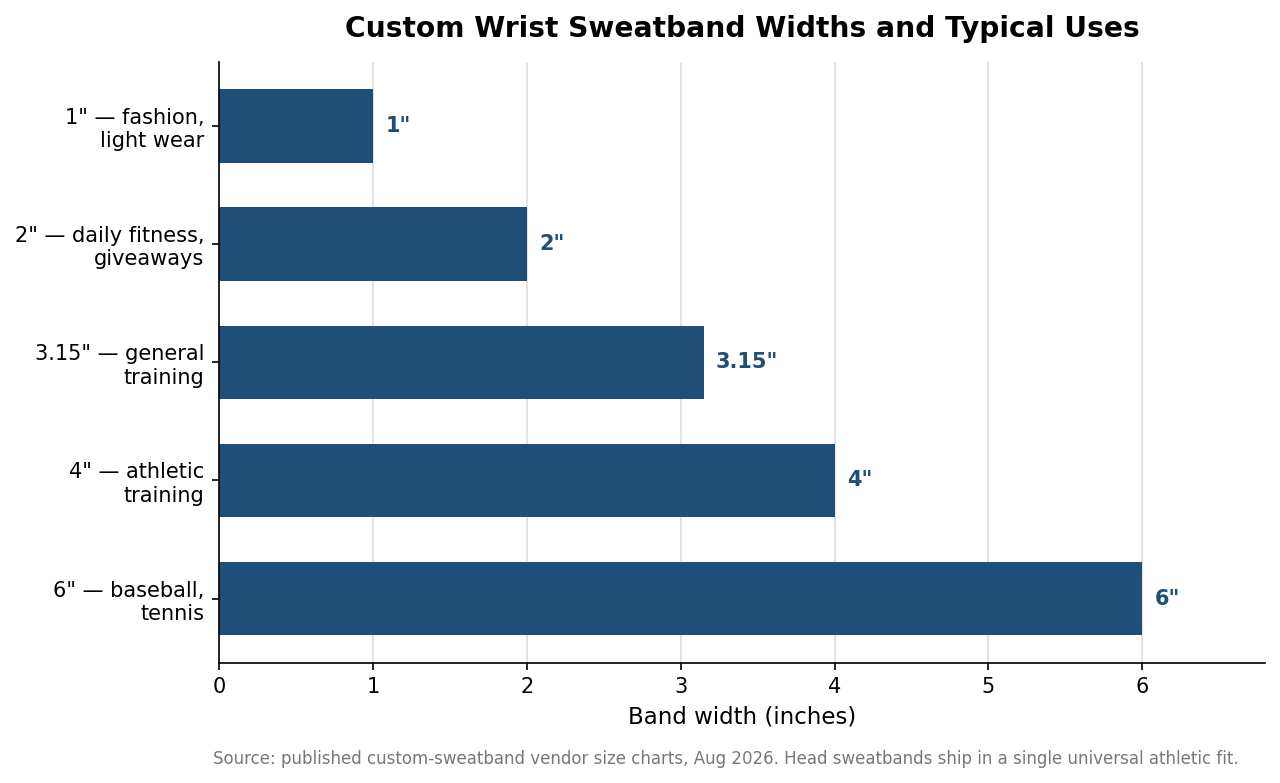
Wrist sweatbands are not one size. Vendors typically stock widths of roughly 1, 2, 3.15, 4 and 6 inches, and the width you choose signals the use as much as the fit. A 1-inch band is really a fashion or light-activity accessory. The 2 to 3.15-inch range is the everyday choice for general fitness and for promotional giveaways, wide enough to carry a readable logo without being bulky. Four inches is a training width that gives embroidery more room and covers more of the forearm. Six-inch bands are the long ones you see in baseball and tennis, where players want coverage well up the arm.
Head sweatbands are usually offered in a single universal athletic stretch fit rather than in graded sizes, so your main decision there is the width of the print area and whether the logo sits centered or repeats around the band. If your mark is wide or carries fine text, size up: a 2-inch wrist band leaves very little vertical room for anything beyond a compact logo.
Decoration: embroidery, printing, or woven
The decoration method is where a logo either reads clearly or disappears, and each method suits a different kind of artwork. Embroidery, where the design is stitched in thread, is the default for team names, monograms and simple bold logos. It is extremely durable, adds a premium raised texture, and looks sharp in one to a handful of thread colors, but it cannot reproduce gradients, photographs or very fine detail, and a large stitched fill can stiffen a small band.
For full-color artwork, gradients or photo-quality detail, choose a printed method such as dye-sublimation or a heat-transfer patch. Sublimation dyes the fibers directly, so the color does not sit on top and crack, and it handles unlimited colors at no extra charge, which makes it the better choice for complex logos and multi-color event graphics. Woven or jacquard bands take a third route: the design is knitted into the fabric itself, giving a clean, flat, durable result that sits between embroidery and print in both look and cost. As a rule of thumb, specify embroidery for a crest or wordmark, printing for anything with photographic or gradient content, and woven when you want the design integral to the band rather than applied on top.
Minimum orders, pricing, and turnaround
Custom sweatbands have become a low-minimum product. Many vendors now start at a handful of units, commonly a 5-piece minimum and in some cases a single piece, often with setup, plate and digital-proof fees waived. That is a real change from the large screen-print minimums of a few years ago, and it makes sweatbands practical for a small club or a one-off event rather than only for bulk campaigns.
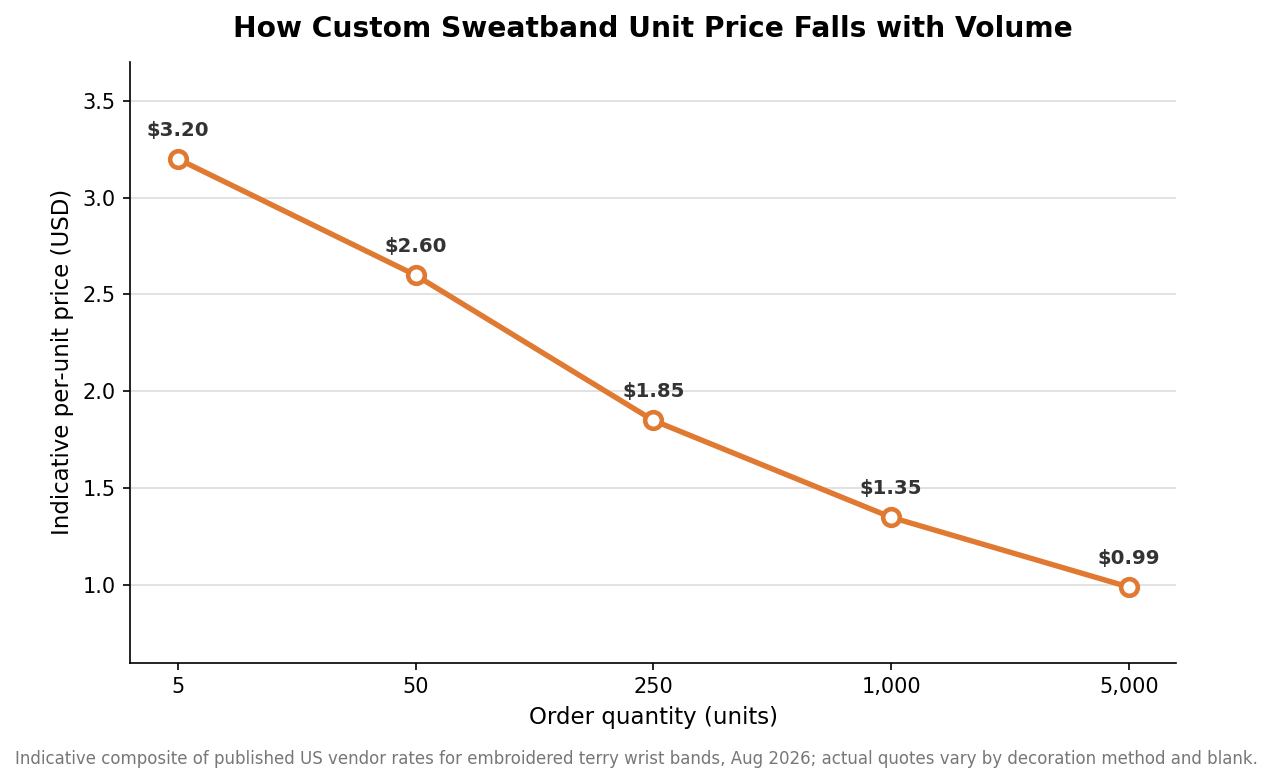
Price moves sharply with volume. Indicative published rates put a single embroidered terry wrist band around $2.99 and a head band around $3.59 at low quantities, falling toward roughly a dollar per unit at bulk volumes in the thousands. Decoration drives the rest of the spread: dense embroidery and multi-layer patches cost more than a simple stitched wordmark, and full-bleed sublimation on a premium blank costs more than a one-color print. Treat any quoted figure as a starting point and get a firm quote against your exact artwork and blank before you plan a budget around it.
On timing, expect a digital proof within about 12 hours of submitting artwork, then production of roughly 3 to 5 business days after you approve that proof, plus another 5 to 7 business days in transit. That is a comfortable two-week window from approval to delivery, with rush options available if you are up against an event date. Build the proof-approval step into your calendar, because it is the part buyers most often forget and the one that quietly eats a deadline.
A pre-order specification checklist
Before you place the order, confirm five things in writing: the fabric blend and its wash rating, the exact band width in inches, the decoration method matched to your artwork, the total quantity and its per-unit price band, and the combined production and shipping lead time against your deadline. Send print-ready vector artwork for embroidery or woven work and a high-resolution file for sublimation, and always ask to see the digital proof before committing. A sweatband is a small item, but specifying it deliberately is the difference between kit your team actually wears and a box of bands that sit unused in a closet.